เนื้อหาหลักสูตร (Program Overview)
หลักสูตรวิศวกรรมศาสตรบัณฑิต สาขาวิชาวิศวกรรมเครื่องกล เป็นหลักสูตรระดับปริญญาตรีที่ได้รับการรับรองจากสำนักงานคณะกรรมการการอุดมศึกษาและสภาวิศวกร หลักสูตรให้ปริญญาวิศวกรรมศาสตรบัณฑิต (วศ.บ.) สาขาวิชาวิศวกรรมเครื่องกล โดยในหลักสูตรนี้เปิดสอนวิชาเอกในสายงานต่างๆ ได้แก่ กลศาสตร์ของเครื่องจักรกล วิศวกรรมความร้อนและของไหล วิศวกรรมพลังงาน วิศวกรรมยานยนต์ วิศวกรรมอากาศยาน เครื่องจักรกลเกษตร การควบคุมอัตโนมัติ แมคคาทรอนิกส์ และวิทยาการหุ่นยนต์
ตามแผนการศึกษา 4 ปี นักศึกษาสามารถเลือกทำการศึกษาในมหาวิทยาลัยผนวกกับการฝึกงานระยะสั้น หรือสหกิจศึกษาที่นักศึกษาสามารถฝึกปฏิบัติงานระยะยาวกับหน่วยงานในภาคอุตสาหกรรม หลังจากสำเร็จการศึกษาในทุกกระบวนวิชาตามหลักสูตรแล้ว นักศึกษาจะสามารถปฏิบัติงานเพื่อตอบสนองความต้องการของภาคอุตสาหกรรม ได้แก่ การออกแบบระบบเชิงกลและความร้อน การซ่อมบำรุงระบบทางวิศวกรรม การติดตั้งเครื่องจักรกลต่างๆ เป็นต้น นักศึกษาที่สำเร็จการศึกษาจากหลักสูตรสามารถขอรับใบอนุญาตเป็นผู้ประกอบวิชาชีพวิศวกรรมควบคุมเพื่อความก้าวหน้าทางวิชาชีพตามเกณฑ์ของสภาวิศวกรได้
Program Educational Objectives (PEO)
เพื่อตอบสนองต่อวิสัยทัศน์ของมหาวิทยาลัย หลักสูตรนี้ได้กำหนดวัตถุประสงค์ของหลักสูตรที่มุ่งผลิตบัณฑิตวิศวกรรมเครื่องกลที่มีคุณลักษณะดังนี้
1)
สามารถประยุกต์วิทยาการและทักษะทางวิศวกรรมเครื่องกลในการแก้ปัญหาทางวิศวกรรมที่จำเป็นต้องอาศัยการคิดเชิงวิเคราะห์และการวางแผนงานอย่างมืออาชีพ
2)
แสดงออกถึงการมีจรรยาบรรณวิศวกร มีความรับผิดชอบต่อความปลอดภัยของสาธารณชน สังคม และสิ่งแวดล้อม
3)
สามารถพัฒนาตนเองเพื่อความก้าวหน้าในวิชาชีพอย่างต่อเนื่องด้วยการศึกษาค้นคว้าด้วยตนเองอย่างเป็นระบบ
4)
สามารถทำงานเป็นทีมร่วมกับผู้คนหลากหลายสาขาอาชีพในฐานะผู้นำหรือสมาชิกของทีมขณะปฏิบัติงานหรือการให้บริการสาธารณะ
ผลลัพธ์การเรียนรู้ (Student Outcomes)
วัตถุประสงค์ของหลักสูตรสามารถบรรลุได้ด้วยการพัฒนาทักษะเชิงเทคนิคทางวิชาการและเชิงวิชาชีพภายใต้กรอบการพัฒนาผลลัพธ์การเรียนรู้ตามแนวทางของ ABET และ TABEE ซึ่งตั้งแต่ปี 2563 เป็นต้นไป ผลลัพธ์การเรียนรู้ที่นิยามตามแนวทางของ ABET ได้ถูกนำมาใช้เป็นเกณฑ์การประเมินผลสัมฤทธิ์ทางการศึกษา ผลลัพธ์การเรียนรู้ดังกล่าวสามารถเทียบเคียงกับผลลัพธ์การเรียนรู้ตามข้อกำหนดของ TABEE ตามเกณฑ์ของสภาวิศวกร
ทักษะเชิงเทคนิคทางวิชาการ (Technical skills)
| Old ABET Student Outcomes | New ABET Student Outcomes |
| A: An ability to apply knowledge of mathematics, science, and engineering | SO-1 An ability to identify, formulate, and solve complex engineering problems by applying principles of engineering, sciences, and mathematics. |
| B: An ability to design and conduct experiments, as well as to analyze and interpret data. | SO-6 An ability to develop and conduct appropriate experimentation, analyze, and interpret data, and use engineering judgment to draw conclusions. |
| C: An ability to design a system, component, or process to meet desired needs within realistic constraints such as economic, environmental, social, political, ethical, health and safety, manufacturability, and sustainability. | SO-2 An ability to apply engineering design to produce solutions that meet specified needs with consideration of public health, safety, and welfare, as well as global, cultural, social, environmental, and economic factors. |
| E: An ability to identify, formulate, and solve engineering problems. | SO-1 An ability to identify, formulate, and solve complex engineering problems by applying principles of engineering, sciences, and mathematics. |
ทักษะเชิงวิชาชีพ (Professional skills)
| Old ABET Student Outcomes | New ABET Student Outcomes |
| D: An ability to function on multidisciplinary teams. | SO-5 An ability to function effectively on a team whose members together provide leadership, create a collaborative and inclusive environment, establish goals plan tasks, and meet objectives. |
| F: An understanding of professional and ethical responsibility. | SO-4 An ability to recognize ethical and professional responsibilities in engineering situations and make informed judgments, which must consider the impact of engineering solutions in global, economics, environmental, and societal contexts. |
| G: An ability to communicate effectively. | SO-3 An ability to communication effectively with a range of audiences. |
| H: The broad education necessary to understand the impact of engineering solutions in a global, economic, environmental, and societal context. | SO-4 An ability to recognize ethical and professional responsibilities in engineering situations and make informed judgments, which must consider the impact of engineering solutions in global, economics, environmental, and societal contexts. |
| I: A recognition of the need for, and ability to engage in life-long learning. | SO-7 An ability to acquire and apply new knowledge as needed, using appropriate learning strategies. |
| J: A knowledge of contemporary issue including economics and engineering management. | SO-7 An ability to acquire and apply new knowledge as needed, using appropriate learning strategies. |
| K: An ability to use the techniques, skills, and modern engineering tools necessary for engineering practice. | SO-7 An ability to acquire and apply new knowledge as needed, using appropriate learning strategies. |
หมวดวิชาในหลักสูตร (Curricular Areas)
หลักสูตรปรับปรุงล่าสุดเริ่มใช้ตั้งแต่ปี 2563 ประกอบด้วยหมวดวิชาต่างๆ ดังนี้
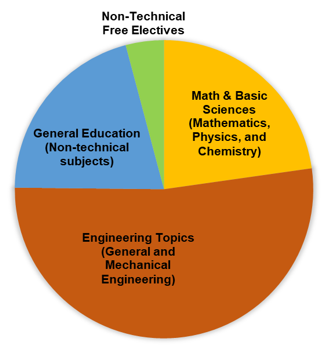
1) คณิตศาสตร์และวิทยาศาสตร์พื้นฐาน
33 หน่วยกิต (23%)
แผนการศึกษา (Study Plan)
Year 1
Semester 1
Semester 2
ENGL 101
Fundamental English 1
3
ENGL 102
Fundamental English 2
3
MATH 161
Calculus for Engineering 1
3
CHEM 162
General CHEM for ENGR Students
3
PHYS 105
PHYS for ENGR & Agro-Industry Students 1
3
CHEM 167
General CHEM LAB for ENGR Students
1
PHYS 115
PHYS LAB for ENGR & Agro-Industry Students 1
1
MATH 162
Calculus for Engineering 2
3
ENGR 103
Engineering Materials
3
PHYS 106
PHYS for ENGR & Agro-Industry Students 2
3
ENGR 104
Engineering Drawing
3
PHYS 116
PHYS LAB for ENGR & Agro-Industry Students 2
1
ENGR 191
Principle of Being Professional
1
ENGR 106
Workshop Technology
1
PG 104
Citizenship
3
ENGR 107
Engineering Mechanics 1
3
Total
20
Total
18
Year 2
Semester 1
Semester 2
ENGL 201
Critical Reading and Effective Writing
3
MATH 362
Applied Differential Equation for Engineers
3
MATH 261
Calculus for Engineering 3
3
ME 200
Mechanical Engineering Design Process
1
EE 285
Fundamentals of Electrical Engineering for ME Engineers
3
ME 205
Mechanical Drawing
2
EE 286
Fundamentals of Electrical Engineering LAB for ME Engineers
1
ME 216
Mechanics of Solids 2
3
ME 206
Engineering Dynamics 1
3
ME 222
Mechanics of Machinery 1
3
ME 215
Mechanics of Solids 1
3
ME 232
Engineering Thermodynamics 2
3
ME 231
Engineering Thermodynamics 1
3
ME 271
Material Property Laboratory for Machine Design Application
1
ME 254
ICE Laboratory
1
ENGR 201
Computer Programming for Engineers
3
Total
20
Total
19
Year 3
Semester 1
Semester 2
ME 302
Computational Methods
4
ENGL 225
English in Science and Tech
3
ME 325
Machine Design 1
3
ME 334
Heat Transfer
3
ME 333
Fluid Mechanics
3
ME 362
Manufacturing Processes for ME
3
ME 372
Computer-Based Instrumentation
3
ME 371
Mechanical Engineering Laboratory 1
1
STAT 263
Elementary Statistics
3
ME 373
System Analysis and Control
3
GE (Co-creator)
3
CS 100
Information Technology and Modern Life
3
ENGR 195
Managing Activities for Development
1
GE Elective Course
3
Total
19
Total
20
Summer Semester
ME 493
Industrial Internship
3
Total
3
Year 4
Semester 1
Semester 2
ME 421
Mechanical Vibration
3
ME 491
Capstone Design Project in ME
3
ME 490
Special Study for Project
1
ENGR 192
Skills for Professionalism and Entrepreneurship
1
ME 444
Design of Thermal Systems
3
Major Elective Course
3
ME 451
Power Plant Engineering
3
GE Elective Course
3
Free Elective Course
3
Free Elective Course
3
Total
13
Total
13
โครงงานแคพสโตนเชิงการออกแบบ (Capstone Design Project)
การจัดตั้งโครงงานแคพสโตนเชิงการออกแบบ (Formulation of Capstone Design Project)
โครงงานแคพสโตนเชิงการออกแบบเป็นโครงงานที่นักศึกษาทุกคนต้องทำในหลักสูตร ในการทำโครงงานนักศึกษาจะต้องลงทะเบียนในกระบวนวิชา ME 490 (Special Study for Project) และ ME 491 (Capstone Design Project in Mechanical Engineering) ต่อเนื่องกันสองภาคการศึกษา สำหรับกระบวนวิชา ME 490 นักศึกษาต้องจัดกลุ่มแล้วสร้างโครงงานแคพสโตนเชิงการออกแบบโดยทุกโครงงานจะต้องมีลักษณะตามเกณฑ์ดังต่อไปนี้:
- โครงงานจะต้องมีการประยุกต์ใช้ความรู้และทักษะที่ได้รับจากกระบวนวิชาในหลักสูตรที่ได้เรียนมาก่อนหน้า
- โครงงานจะต้องเป็นโครงงานการออกแบบเชิงวิศวกรรม ซึ่งมีสาระสำคัญคือ การออกแบบระบบ ชิ้นส่วน หรือกระบวนการ ที่มีการนำเอามาตรฐานทางวิศวกรรมและเงื่อนไขที่เป็นจริงมาใช้เป็นหลักในการออกแบบ
- โครงงานจะต้องเกี่ยวข้องกับการแก้ปัญหาเชิงวิศวกรรมซับซ้อนในวิชาชีพวิศวกรรมเครื่องกล
ตัวอย่างที่ข้อโครงงาน ได้แก่ การออกแบบเครื่องพาสเจอไรซ์ เครนเคลื่อนที่ และแขนหุ่นยนต์แบบสองแกน เป็นต้น
กิจกรรมแคพสโตนเชิงการออกแบบ (Capstone Design Activities)
นักศึกษาที่ลงทะเบียนในกระบวนวิชา ME 491 จะต้องทำโครงงานให้ลุลวงตามที่ได้นำเสนอต่อกระบวนวิชา ME 490 ในภาคการศึกษาก่อนหน้า นักศึกษาบางกลุ่มอาจทำโครงงานตามลำดับ 4 ขั้นตอน คือ “วิเคราะห์ ออกแบบ สร้าง และทดสอบ” โดยประยุกต์ใช้ความรู้ด้านการออกแบบเชิงวิศวกรรม เทคนิคการสร้าง และการสังเคราะห์การทดลอง ทั้งนี้เพื่อสร้างและทดสอบต้นแบบ ส่วนโครงงานที่เกี่ยวข้องกับการออกแบบเชิงวิศวกรรมที่มีความซับซ้อนมากอาจจะมุ่งทำการวิเคราะห์และออกแบบทางวิศวกรรมเท่านั้น ตัวอย่างของโครงงานประเภทนี้ ได้แก่ การออกแบบระบบเครื่องปรับอากาศสำหรับอาคารขนาดใหญ่และระบบทำความเย็นทางอุตสาหกรรมสำหรับการจัดเก็บอาหาร เป็นต้น
เงื่อนไขสำหรับการเสร็จสิ้นการทำโครงงานแคพสโตนเชิงการออกแบบในกระบวนวิชา ME 491 (Conditions for the completion of ME 491 Capstone Design Project)
- ส่งเล่มรายงานฉบับสมบูรณ์สำหรับการสอบโดยกรรมการสอบ
- นำเสนอโครงงานด้วยวาจาต่อกรรมการสอบ
- นักศึกษาที่เรียนตามหลักสูตรเก่า พ.ศ. 2558 จะต้องสอบผ่านกระบวนวิชา STAT 101 (208101) หรือ STAT 161 (208161) อย่างใดอย่างหนึ่ง ซึ่งจะได้รับ 3 หน่วยกิตจากทั้งหมด 6 หน่วยกิตที่บังคับในกลุ่มวิชาวิทยาศาสตร์และคณิตศาสตร์ของหมวดวิชาศึกษาทั่วไป
หมายเหตุ: นักศึกษาที่สอบไม่ผ่านกระบวนวิชา STAT 101 (208101) หรือ STAT 161 (208161) จะได้รับเกรด P (In Progress) ในกระบวนวิชา ME 491 และจะได้รับเกรดสุดท้ายเมื่อผ่านเงื่อนไขนี้แล้ว
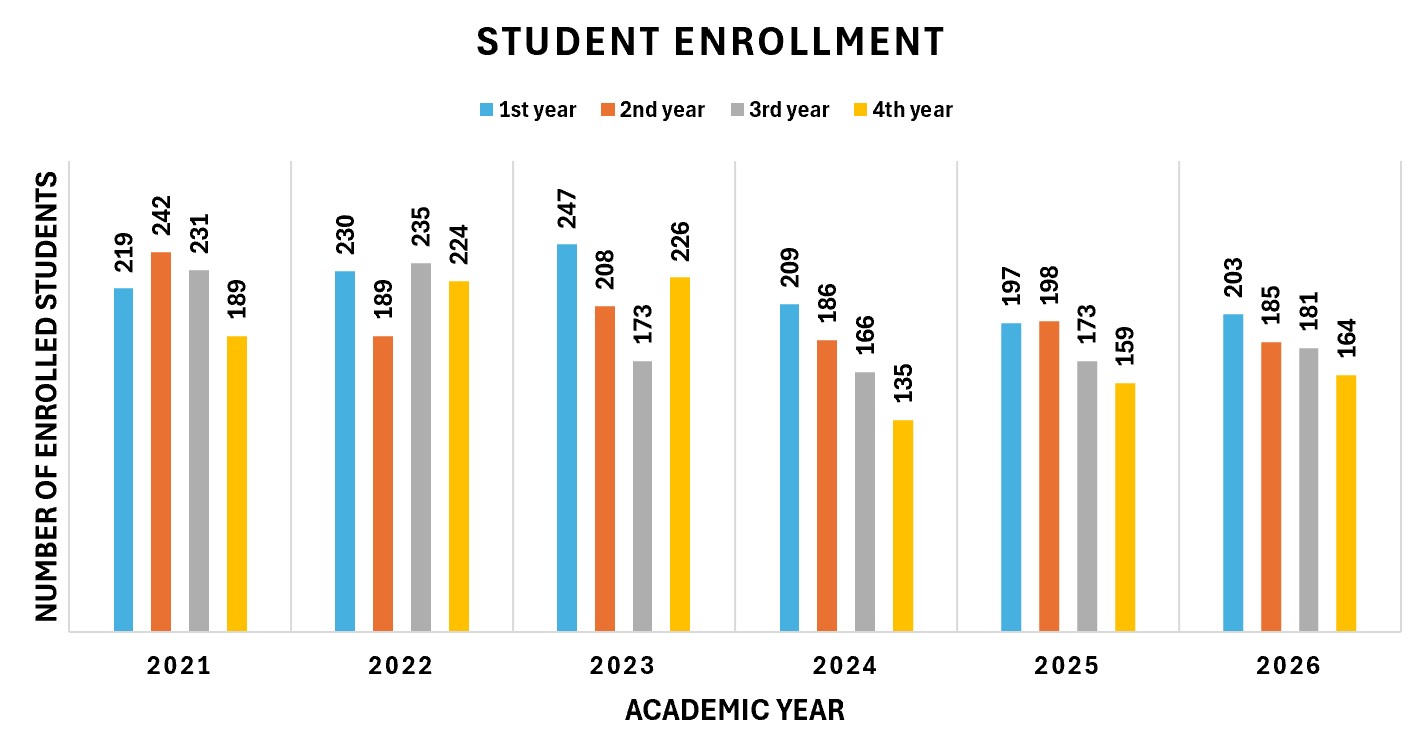
นักศึกษาปัจจุบัน (Enrolled Students)
ปัจจุบันมีนักศึกษาทั้งหมดในหลักสูตมากกว่า 800 คน
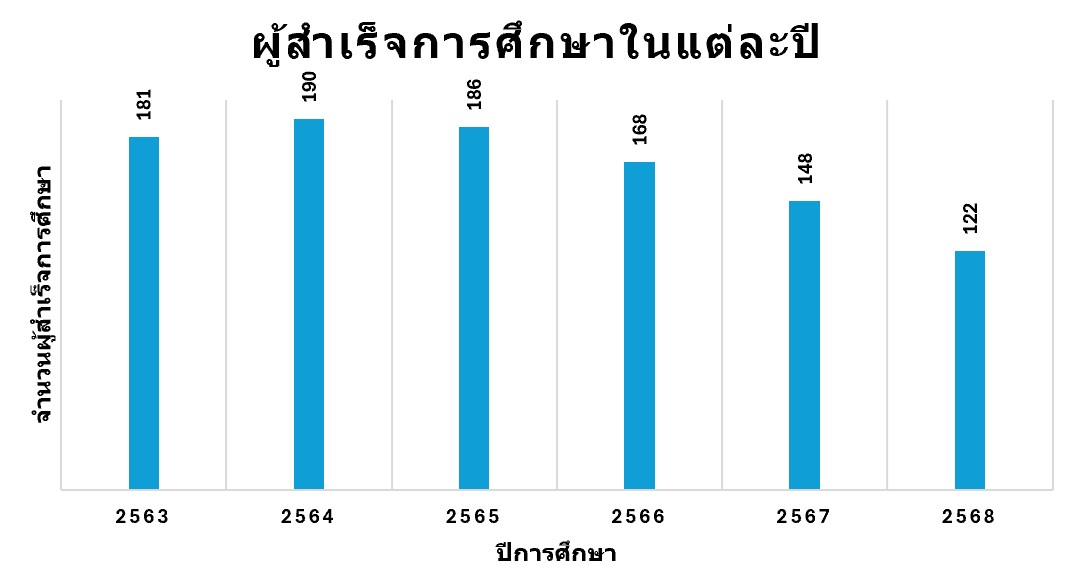
ผู้สำเร็จการศึกษา (Graduates)
แต่ละปี มีนักศึกษาที่จบการศึกษาจากหลักสูตรจำนวน 122-190 คน
ในช่วง 5 ปีย้อนหลังมีผู้สำเร็จการศึกษาเฉลี่ย 161 คนต่อปี
การรับเข้าศึกษา (Student Admission)
คุณสมบัติของผู้สมัครเข้าศึกษา
-
สำเร็จการศึกษาระดับมัธยมศึกษาตอนปลายหรือเทียบเท่า
กระบวนการรับเข้า
-
การรับเข้าศึกษาเป็นไปตามระบบ Thai University Central Admission System (TCAS)
จำนวนนักศึกษารับเข้า
-
200 คนต่อปี
ข้อมูลเพิ่มเติม (More Information)
สำหรับข้อมูลเพิ่มเติม โปรดติดต่อสำนักงานภาควิชาวิศวกรรมเครื่องกล
ที่อยู่:
ภาควิชาวิศวกรรมเครื่องกล
คณะวิศวกรรมศาสตร์ มหาวิทยาลัยเชียงใหม่
239 ถนนห้วยแก้ว ต.สุเทพ อ.เมือง
จ.เชียงใหม่ 50200
โทรศัพท์:
053 944146
โทรสาร:
053 944145